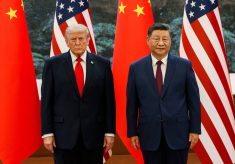
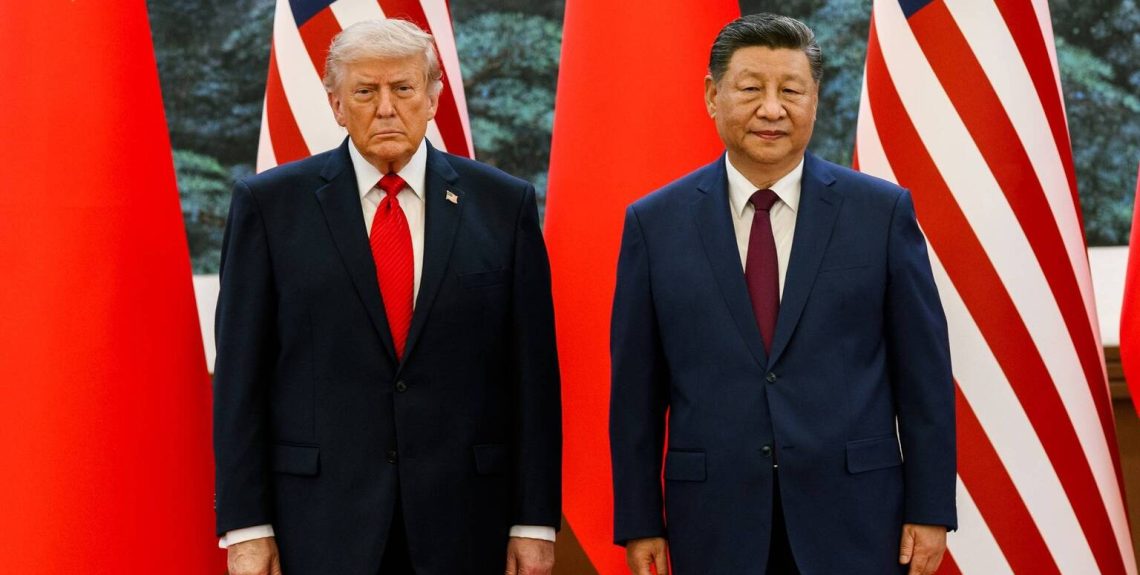
Donald Trump’s recent three-day visit to China left many observers surprised, especially those expecting the usual quite visible performance from the American president. Trump was unusually restrained: he spoke little to reporters and largely stayed away from social media.
Then, aboard the Air Force One on the flight back home, he finally broke his silence. Pressed by journalists about the $11 billion arms package for Taiwan that he had authorized last December, but which has yet to be delivered, Trump said he had not yet decided whether to proceed with the sale.
“President Xi and I talked a great deal about Taiwan,” he remarked, adding that the Chinese leader “does not want to see an independence struggle because it would lead to a very serious confrontation.” “I listened to him,” Trump said, “but I made no comment”. Yet once safely beyond Chinese airspace, he declared: “The last thing we need right now is a war 9.500 miles away”. The statement appeared to be a concession to President Xi Jinping, who on the opening day of the state visit had issued a stark warning: “If Washington mishandles its relationship with the self-governing island of Taiwan, the United States and China could end up clashing or even entering into open conflict”. By the way, also the National Defense Strategy, by the Department of War, talks explicitly about the need of a decent peace to be reached through de-escalation, realistic diplomacy and the sufficient strength to have the right leverage.
On the conflict in Iran, Trump stated that Xi agreed with him that a nuclear-armed Iran would be “a terrible idea” and that the Strait of Hormuz should be reopened. He also told that Xi had even offered to help broker a definitive solution to the war. Publicly, China merely stated that any resolution should “take into account the concerns of all parties involved in the Iranian nuclear issue”. It is already a tradition to have different readouts of a summit.
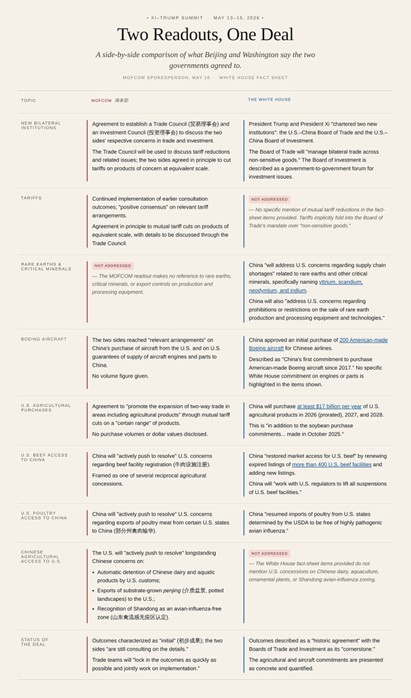
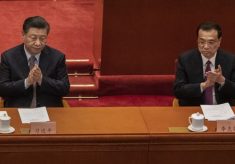
The visit itself also proved surprising for another reason. Unlike his usual style (often marked by direct remarks about foreign leaders who do not align with his international political agenda), Trump, once in Beijing, lavished praise on Xi at every opportunity, while the Chinese president was characteristically much more reserved. Xi limited himself to saying that Trump’s “historic visit” had strengthened mutual trust and promised to send rose seeds to the White House, similar to those grown in the garden of his residence, where he said he had hosted Trump in return for the hospitality the American president had shown him during Xi’s visit to Trump’s Mar-a-Lago estate in Florida in 2017. In the end, there was plenty of ceremony and little else concrete in the short term. On may hope that, after positive atmospherics, some worthwhile political and economic deals will follow in due time.