The New START (Strategic Arms Reduction Talks) strategic treaty between Russia and the United States, that limited each side to 1.550 deployed nuclear warheads and 700 delivery systems, was the last remaining arms control agreement between the world’s two largest nuclear powers. It expired on the 5th of February this year.
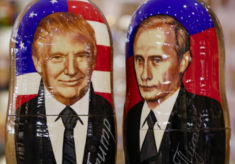
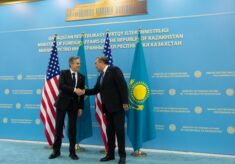
At the last minute, Vladimir Putin proposed maintaining the treaty’s quantitative limits for one year while renouncing its provisions on verification, information exchange and transparency. Donald Trump initially signalled some openness to the proposal, but ultimately, he allowed the treaty to lapse, thus assuming primary political responsibility for its demise.
For different reasons, neither leader had ever been particularly fond of New START. Neither had negotiated or signed it: the agreement was concluded in 2010 by Barack Obama and Dmitry Medvedev. Putin has long viewed the treaty as an inconvenient constraint, particularly due to its intrusive verification regime. Trump regarded it with suspicion not only because it was a legacy of the Obama administration, but also because he sought a new agreement that would include China.
According to US DoD estimates (2025 Report to Congress), China’s nuclear arsenal, which only a few years ago stood at around 250 warheads, has now doubled and could double again by the end of the decade, up to more than 1.000 warheads. Beijing, however, does not provide official data and has no intention, at this stage, of joining negotiations on its nuclear forces.
Russia continues to favour a bilateral framework and argues that any broader negotiation should also include the arsenals of France and the United Kingdom, which, according to NATO doctrine, “contribute to the common security” of the Alliance. Like Beijing, Paris and London have shown no interest in placing their nuclear forces on a wider negotiating table; while Paris has announced an unspecified increase of its stockpile on the 2nd of March. For now, therefore, the idea of an expanded agreement appears difficult to realize.
What Trump evidently fears is the prospect of confronting an increasingly coordinated Sino-Russian strategic posture, something the Biden presidency took already seriously. Yet while Beijing and Moscow deepen their strategic cooperation, Washington is doing the opposite by weakening relations with its European partners, thereby undermining the Western unity that is now more necessary than ever.
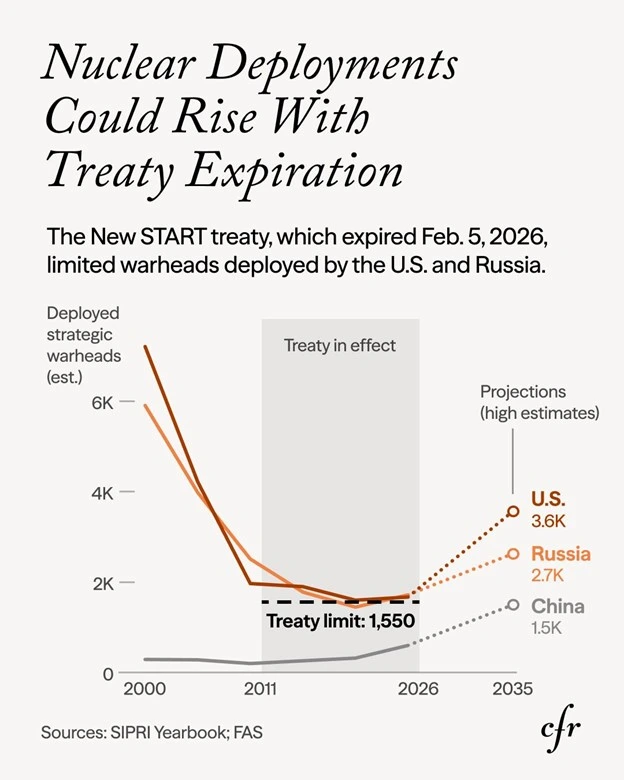
With the end of New START, no legal constraints remain to prevent Russia and the United States from increasing their strategic arsenals at will. The 2017 Treaty on the Prohibition of Nuclear Weapons (TPNW), which bans the possession, use, and deployment of nuclear arms, is formally in force but has not been signed or ratified by any nuclear-weapon state. In Europe, only a handful of countries have joined it.
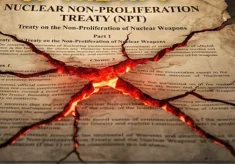
The Nuclear Non-Proliferation Treaty (NPT) is now the only major global agreement still in force. It allows only five states (China, France, Russia, UK, USA) to possess nuclear weapons, which remain prohibited to all other countries. Under Article VI, these five nuclear powers are expected to negotiate nuclear disarmament in good faith. So far, however, they are widely considered to be far from achieving that objective. The expiration of New START, without a replacement agreement, is clearly a step backwards.
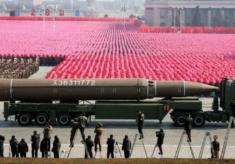
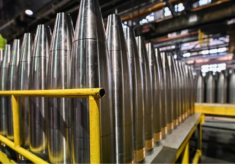
The disappearance of New START is likely to open the door to a new arms race. The existing nuclear arsenals of both sides are already more than sufficient to trigger a nuclear Armageddon, at least in the Northern Hemisphere (the Southern Hemisphere is largely covered by nuclear-weapon-free zones). The competition may become qualitative rather than purely quantitative, at least between Russia and the United States. Nevertheless, the overall trend points to a global increase in nuclear arsenals.
At the NPT Review Conference to be held in New York next April, the five nuclear-weapon states will have little to report in terms of progress toward nuclear disarmament that might justify their privileged nuclear status. Other countries may therefore be tempted to withdraw from the treaty and pursue their own nuclear capabilities.