“The spirit of our endeavour is, To strive, to seek, to find and not to yield”


Alessandro Minuto-Rizzo, President

Monthly Journal

June 2026

International Press Review

The most relevant events of the area through international sources

Bosnia’s OHR succession remains stuck
OHR, The Guardian
The Peace Implementation Council has still failed to agree on Bosnia and Herzegovina’s next High Representative, leaving Christian Schmidt’s succession unresolved. Washington had pushed for Italian diplomat Giovanni Zanardi Landi, but European capitals refused to back him and have instead looked at alternatives, including France’s René Troccaz. The dispute has become a test of Western cohesion in Bosnia: the US is pressing for a rapid change at the OHR, while Europeans fear that a weak or politically disputed appointment could destabilise Dayton oversight and benefit Republika Srpska’s separatist leadership. The PIC said it aims to complete the appointment by 14 July.
Albania’s NATO summit plan hits uncertainty
Reuters
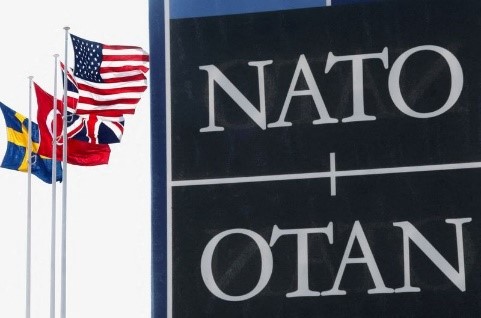
Plans for Albania to host a key-NATO summit in 2027 have been thrown into doubt amid US reluctance and concern over Tirana’s low defence spending. A draft statement for July’s summit in Ankara reportedly no longer names Albania as the venue, despite an earlier NATO declaration pointing to a meeting there, Reuters reported. The issue is politically difficult for PM Rama: hosting the summit would crown Albania’s pro-Western profile, but Washington is pressing allies to show faster progress on defence budgets. Tirana says new fiscal measures will lift 2026 defence and security-related spending to 2,6% of GDP, but the final decision remains open.
Serbia’s Chinese air-defence network draws scrutiny
Military Watch
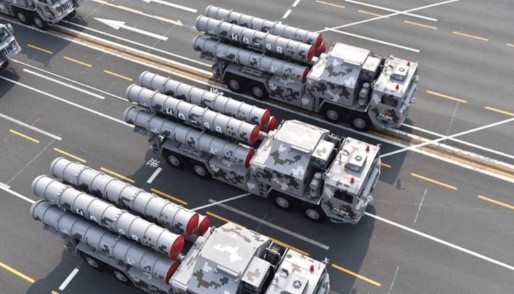
Serbia is allegedly completing a multilayered Chinese air-defence network, with the procurement of HQ-9 long-range missile systems now confirmed. Military Watch presented the system as the top layer of an architecture already including Chinese FK-3 batteries, drones and other equipment, giving Belgrade one of the more advanced non-NATO air-defence systems in Europe. The purchase can be read as a strategic signal: Serbia is modernising fast while keeping defence ties with Beijing open despite EU pressure.
Vučić says conscription will return in March 2027
Novinite
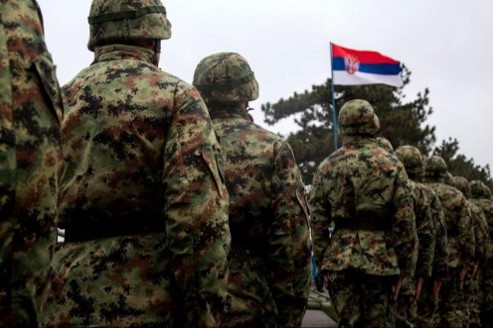
Serbia will reintroduce compulsory military service in March 2027, President Aleksandar Vučić said, reviving a draft suspended in 2011. The plan foresees 75 days of service for men under 30, combining 60 days of training and 15 days of exercises, while service for women would remain voluntary. Belgrade presented the move as necessary to strengthen the army amid a more unstable regional and European security environment. Critics, however, question whether such a short draft can significantly improve defence capacity, warning instead of high costs and political symbolism.
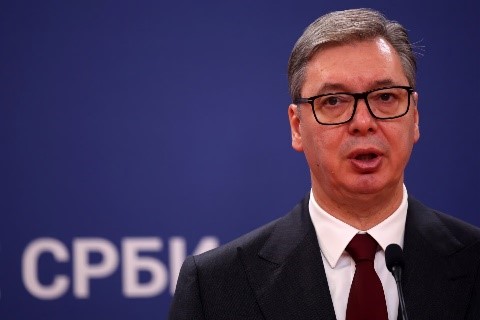
Vučić resignation pledge fuels power-shift speculations
Politico
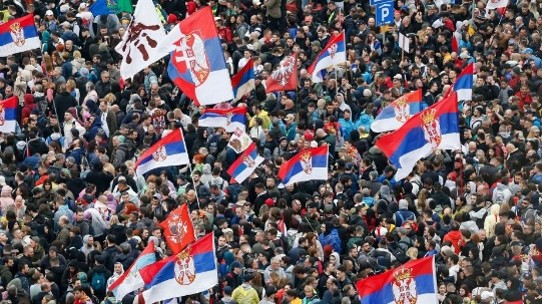
Politico reported that Aleksandar Vučić’s announced, during a mass demonstration in Belgrade, that he will resign within weeks, opening the way for early presidential and parliamentary elections after months of student-led protests. However, the move does not necessarily mean an exit from power: Vučić is barred from another presidential term, but could seek to return as prime minister if his SNS party wins. The announcement therefore looks less like a retreat than a possible reset of Serbia’s political architecture under pressure from the streets, Politico noted.
EU presses Serbia on “sound cannon” probe
Vreme
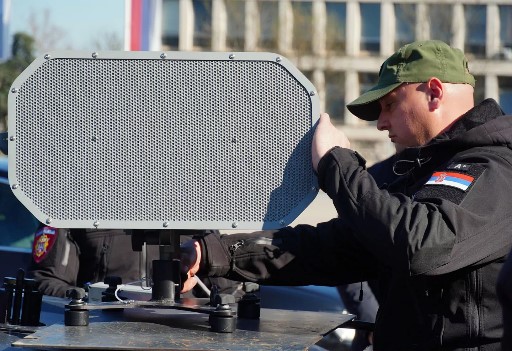
The European Commission has again urged Serbia to conduct a credible and transparent investigation into allegations that police used a sonic weapon against protesters in Belgrade on 15 March 2025. Brussels said any inquiry must be free from political pressure and respect freedom of assembly and expression. The case remains highly sensitive: Serbian authorities deny the weapon was used, while prosecutors have opened proceedings alleging that students and activists “faked” the incident — a move that has further fuelled rights concerns around the case.

Serbian prosecutors target students over “sound cannon” claims
Intellinews, BBC (photo)

Serbian prosecutors have suggested that the student movement in Serbia staged a “sound cannon” hoax linked to the mass Belgrade protest of 15 March 2025. The case adds a new twist to one of Serbia’s most sensitive protest controversies: by pursuing students and activists over the allegation, prosecutors have fuelled fears that the case is shifting from accountability for possible police abuse toward pressure on those demanding answers.

EU Parliament grades Balkan enlargement unevenly
European Parliament
, PubAffairsBruxelles (photo)
The European Parliament’s latest enlargement reports underlined a widening gap in the Western Balkans. MEPs praised Montenegro’s ambition to finish negotiations by 2026 and join the EU by 2028, and welcomed Albania’s recent progress, while warning that reform quality will decide the timetable. By contrast, they flagged Kosovo’s institutional paralysis, Bosnia’s obstructionism and North Macedonia’s lack of progress, especially on rule of law and constitutional changes.
Albania’s “flamingo revolution” targets elite tourism
The Guardian
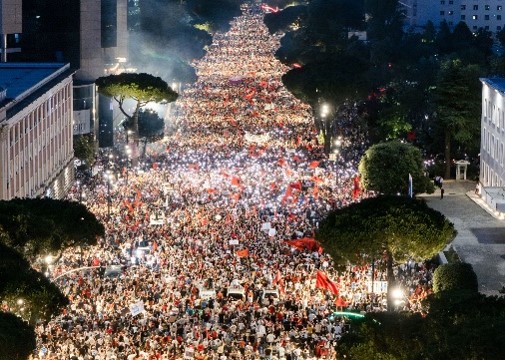
A month-long protest wave against Jared Kushner and Ivanka Trump-backed resort projects on Sazan island and the Zvërnec peninsula have turned into a broader revolt against Albania’s political and business establishment. Opponents say the schemes threaten protected coastal ecosystems, public access and one of the country’s most symbolic landscapes. Prime Minister Edi Rama defended the 1,4-billion investment as a route to high-end tourism and EU-style development. But the protests now go beyond one resort: they channel anger over corruption, opaque strategic-investor laws and a model of growth seen as serving wealthy outsiders while many Albanians still leave the country, The Guardian wrote.
Serbia moves to shield NIS from sanctions
Reuters
Serbia has completed talks on a shareholders’ agreement with Hungary’s MOL over the sanctioned oil company NIS, in a bid to keep its only refinery running while reducing exposure to Russian ownership. NIS is majority-owned by Gazprom Neft and Gazprom, while the Serbian state holds around 30% of the shares. Under the planned arrangement, MOL would take over the Russian stakes and Serbia would buy an additional 5%, gaining stronger rights over strategic decisions. The deal is less about normal business than geopolitical damage control: Belgrade is trying to preserve energy security, satisfy US sanctions demands and avoid a politically explosive full break with Moscow. However, Russia has still not approved the sale of its shares.

The Insight Angle

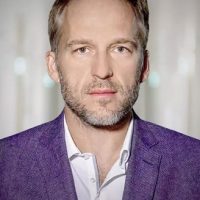
Immagine12

Vedran Džihić

Vedran Džihić is Senior Researcher at the Austrian Institute for International Affairs (oiip), Co-Director of the Center for Advanced Studies in Rijeka, and Senior Lecturer at the University of Vienna and the Vienna Master of Applied Human Rights programme at the University of Applied Arts Vienna. He is the founder and Executive Board member of IDESE – Institute for Democratic Engagement Southeast Europe. A specialist in democratisation, European integration, migration, and the Western Balkans, Džihić has held a Marshall Plan Fellowship at the Center for Transatlantic Relations, Johns Hopkins University SAIS in Washington, D.C. He currently coordinates the Jean Monnet Network Western Balkans to the EU and leads a project on transatlantic approaches to the Western Balkans supported by the Austrian Marshall Plan Foundation. He also serves on the board of Austria’s community television station OKTO. A frequent commentator in media on Balkan affairs, Džihić is the author and editor of numerous books, scholarly articles, policy papers, and opinion pieces. His most recent book, Ankommen, combines personal memoir with political reflection, tracing his journey from a Bosnian war refugee arriving in Austria in 1993 to becoming a recognised scholar and public intellectual.

The EU–Western Balkans Summit in Tivat generated positive political messaging, but what concrete results emerged from the meeting?
The Tivat Summit has not produced any dramatic breakthrough. It was lastly most important to firmly anchor Montenegro’s progress and ambitions within the enlargement framework.
Montenegro, which moves steadily towards the EU, could become a test case proving that the EU is again capable of delivering enlargement, despite some internal challenges in Montenegro (a lot of formal passing of legislation quite fast without guarantees of implementation, state of the coalition government with strong Serbian part in it, new elections in 2027) and big questions marks within the EU (ratification procedure for the accession agreement).
Of course, we also got the confirmation that a shift in the political atmosphere around enlargement is real. For many years enlargement had been marked by fatigue, ambiguity and declining credibility, not it is time that positive political messaging turns into concrete steps.
The French German paper pushed for the gradual integration, the Growth Plan is still on the table, closer security cooperation and the need to connect the region more closely to the Single Market is noted. These are not insignificant steps but still do not guarantee outcomes.
I think that we should be optimistic but cautious. The summit did not manage to substantially address the core problems in the region incl. weak rule of law, democratic backsliding, bilateral disputes, EU-internal vetoes and the absence of a fully credible timetable. The most concrete potential lies in the combination of gradual integration and accelerated accession for frontrunners such as Montenegro and Albania, even though Albania and its prime minister Edi Rama are at a critical juncture given the huge protests in Albania, the Pink Flamingo protests.
Tivat created fragile momentum rather than a decisive turning point. It opened a window, but whether this window leads to real accession progress depends on political courage in Brussels and reform seriousness in the region.
 
Montenegro and Albania are widely seen as the frontrunners for EU accession, while the rest of the Western Balkans remain significantly behind. What consequences could arise from such an uneven enlargement process?
An uneven enlargement process can have both positive and negative consequences. On the positive side, the accession of Montenegro, and later possibly Albania, could finally break the long-standing blockade of enlargement. It would send a powerful signal that reforms matter and that EU membership is not an empty promise. Montenegro is a particularly suitable candidate in this respect: it is small, relatively advanced in negotiations and represents a “low-risk, high-impact” opportunity for the EU. Its accession could restore credibility and create positive pressure on others.
But there are also serious risks. If Montenegro and Albania move ahead while Serbia, North Macedonia, Bosnia and Herzegovina and Kosovo remain stuck, the region could become more fragmented. Citizens in the countries left behind may interpret this not as merit-based differentiation, but as geopolitical arbitrariness or political exclusion. This could deepen cynicism, weaken pro-European forces and give more space to nationalist, authoritarian and external actors, including Russia and China, most prominently in Serbia and partly in Bosnia and Herzegovina.
The case of Albania also shows the dilemma clearly. Albania has made important progress in the accession process, but democratic backsliding, media pressure and the concentration of power under Edi Rama cannot be overlooked. As I said, recent protests are exposing Rama’s rule at home and also having an impact on EU’s approach to Albania. The EU Commission still seems to be ready to stand by Edi Rama, but should the protest intensify and continue putting pressure on Rama the EU will need to reevaluate its approach. If the EU accelerates accession while compromising on democratic standards, it risks reproducing the old logic of stabilitocracy, rewarding leaders who promise stability while weakening democracy. Therefore, differentiation can work only if it remains strictly merit-based, transparent and anchored in democracy and rule of law. Otherwise, uneven enlargement may solve one credibility problem while creating another.
 
The Franco-German proposal envisages gradual integration before full membership. How realistic is this model, and could it serve as an effective bridge towards accession?
Gradual integration is a possible next step, and in principle it could work. It goes beyond saying that the long waiting period has exhausted societies in the Western Balkans and weakened the transformative power of the EU. Offering access to parts of the Single Market, EU programmes, energy cooperation, research, education, infrastructure and selected institutional formats before full membership could make the accession process more concrete and tangible. It could show citizens that reforms produce concrete benefits before the final moment of accession.
The Franco-German proposal therefore points in the right direction. It reflects the fact that enlargement can no longer be imagined only as a binary process – either outside or fully inside. A staged model could help maintain momentum, support reforms and prepare both the candidate countries and the EU for future membership. It could also reduce the political shock of enlargement by allowing gradual adaptation.
However, the risk is obvious. Gradual integration must not become a substitute for membership. If candidate countries receive limited benefits but no real path to full accession, the model could institutionalize a second tier of Europe. That would be deeply damaging. The Western Balkans have already experienced too many promises without delivery. Any gradual model must therefore be reversible, merit-based and linked to a clear accession perspective. Participation without voting rights, market access without political equality, and endless conditionality without a final date would not rebuild trust.
In short: gradual integration can be a bridge, but only if the bridge clearly leads somewhere. It must complement accession, not replace it.
 
How confident should the Western Balkans be that enlargement is currently a genuine strategic objective, rather than a long-term aspiration with no clear timetable?
The Western Balkans should take the current enlargement momentum seriously, but not naively. There is a real geopolitical shift. Russia’s war against Ukraine, the growing influence of China and Russia in Southeast Europe, and the EU’s need to act as a geopolitical player have changed the debate. Enlargement is again described in Brussels, Berlin and Paris as a strategic geopolitical and security necessity. This is more than rhetoric. The renewed focus on the Growth Plan, gradual integration and the possible accession of Montenegro by 2028 suggests that the EU is looking for some concrete success.
Still, credibility remains fragile. The EU has promised a European future to the Western Balkans for more than two decades, while the region has often remained in the waiting room with some countries with no real perspective right now like Kosovo and countries with huge backlash like Serbia, Bosnia and Herzegovina and North Macedonia. Internal EU reforms, unanimity, enlargement fatigue, bilateral disputes and the rise of illiberal actors incl. possible take-over of the French presidency by a far-right politician, continue to complicate the process. The EU is also preoccupied with Ukraine, security, economic competition and institutional reform. These priorities may strengthen the geopolitical case for enlargement, but they may also delay it.
Therefore, confidence should be conditional. The Western Balkans should believe in the opportunity, but demand clarity, consistency and delivery. The EU must prove that enlargement is not only a strategic narrative but a political project with deadlines, resources and consequences. Montenegro will be the crucial test. If its progress is rewarded, the EU’s credibility will increase. If even Montenegro remains blocked, the message to the region will be devastating that enlargement remains a promise without a date.
The Key Story

Strategic trends 

Source: Euronews

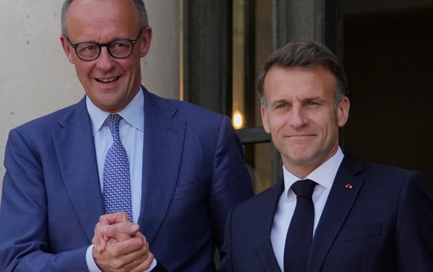
Germany and France push for a “gradual integration” of the Western Balkans

With Montenegro now the clear frontrunner for EU accession, and Albania rushing through the negotiation process, enlargement to the Western Balkans appears to have regained momentum. Yet, much of the region remains far from the goal. To keep the rest of the countries in the region anchored to the EU in the meantime, an old idea has resurfaced in a relative new form at the EU–Western Balkans summit in Tivat, held in June.
The idea has been taken up by Germany and France, the EU’s two main powers, which have presented a non-paper on enlargement aimed at injecting fresh momentum into a process largely stalled for years. The document, titled “A New Momentum for Enlargement,” was made public, among others, by Agence Europe.
Twenty years after the Thessaloniki Summit, “enlargement remains one of the most attractive offers and most influential policy instruments the Union has,” the document prepared by Berlin and Paris says. But after years of delay, it adds, “enlargement policy needs a new momentum” — one that can be generated through “additional incentives” as part of a “gradual integration process.”
Berlin and Paris therefore used the Tivat summit to propose a kind of “pre-accession strategy” built around a toolbox of measures designed to bring candidate countries closer to the EU through more structured gradual integration while offering fresh incentives for reform. “The aim of full EU membership remains unaffected. Our intention is neither to replace full EU membership nor to prolong the path towards it, but the opposite,” the non-paper claims.
In concrete, the French German Plan includes the participation of representatives of Western Balkans countries and Moldova to informal meetings of the European Council, but also at official summits on specific topics, as observers without voting rights, provided that candidate countries have closed the relevant negotiations chapters.
The plan also envisages including the Western Balkans and Moldova in major EU programmes and initiatives, including Creative Europe, Digital Europe, formal association with Erasmus+, deeper integration into Horizon Europe, a Youth Experience Scheme, participation in EU joint-procurement pooling mechanisms, full access to the Technical Support Instrument, and the strengthening of Twinning and TAIEX in relevant areas.
Its most important proposal, however, concerns sectoral integration into the Single Market. The non-paper lists areas including SEPA, ‘Roam Like at Home’, the Transport Community, agreements on conformity assessment and acceptance of industrial products, known as ACAAs, the energy market, the Emissions Trading System, green lanes, EU competitiveness, industrial and critical raw-materials policies, Authorised Economic Operator status, the Digital Single Market, more far-reaching sanitary and phytosanitary agreements, further reductions in non-tariff trade barriers, and exemptions from some safeguard measures similar to those enjoyed by EEA states.
Such access would depend on candidate countries meeting the relevant standards and requirements or provisionally closing the relevant negotiating chapters. In effect, it would be a precondition for fuller participation in the Single Market, based on an EEA+ model.
The plan also floats the idea of holding joint meetings between the European Commission and MEPs, on one side, and representatives of Western Balkan candidate countries on the other.
The Franco-German non-paper on “structured gradual integration” dominated the summit debate and was seen as the latest in a long line of initiatives promising to accelerate integration without substituting for full membership. The proposal was received as a potentially useful attempt to revive enlargement, with Germany’s Merz claiming that the proposal received “broad support.”. EU leaders, meanwhile, used the Tivat summit to frame enlargement as politically real again, with Merz adding that the Union had to prove it was “ready and able” to expand, and Ursula von der Leyen stressing that Montenegro’s accession was now “within reach.”
But the reception was, to some extent, also cautious. Analysts noted that many elements resembled ideas already contained in the EU Growth Plan, making the non-paper look less like a revolution than a repackaging of gradual integration. Others pointed to similarities with earlier regional proposals, including the so-called Vučić–Rama plan, with the two leaders suggesting the inclusion of “prepared” Western Balkans candidates to the Single Market and Schengen area.
However, the Franco-German plan also carries implicit risks, particularly the danger of further dividing the Western Balkans. With Kosovo still lacking candidate status, Bosnia and Herzegovina yet to open accession negotiations, and North Macedonia blocked by Bulgaria’s veto, only Albania, Serbia and Montenegro could, in theory, benefit quickly from the new rules.
On paper, these countries could accelerate reforms and gain access to parts of the Single Market within a few years. But that would also deepen regional asymmetries, potentially widening the gap between frontrunners and those still trapped in political or bilateral blockages.

Further News and Views

Kurti wins again the elections in Kosovo, but with no majority
Sources: Kossev, DW, ANSA, European Western Balkans
Albin Kurti’s Vetëvendosje has won Kosovo’s snap parliamentary election again, but without the majority needed to end the country’s political deadlock.
Official results from the 7 June vote gave VV 47,13% and 53 seats in the 120-seat Assembly, ahead of the Democratic Party of Kosovo with 22 seats, the Democratic League of Kosovo with 18, and AAK with 7. The Serb List won 9 seats, while Nenad Rašić’s list secured one.
The result confirms Kurti as Kosovo’s dominant political figure but also leaves him short of the 61 MPs needed to govern alone and far from the broader majority required to resolve institutional questions, including the choice of the new president. The election was seen as another attempt to produce a functioning parliament after months of institutional paralysis.
The political arithmetic, however, remains almost unchanged. Kurti will have to seek an agreement with one of the major Albanian opposition parties, most plausibly LDK, or try to assemble support from minority MPs. But every option carries costs: opposition parties campaigned against his confrontational style, while cooperation with the Belgrade-backed Serb List remains highly sensitive.
The vote also exposed voter fatigue. Turnout fell sharply from the previous election, a sign that repeated ballots and institutional deadlock are eroding public confidence. For Kosovo, the risk is not only another difficult coalition negotiation, but another cycle of blocked institutions at a time when talks with Serbia, EU integration and international credibility all require a functioning government.
Montenegro blocks entry of 87 Serbs ahead of EU summit in Tivat
Sources: AP, Balkans Insight, European Western Balkans, Reuters
Just before the key EU–Western Balkans summit in Tivat, a potential scandal, and a serious incident related to security, erupted in Montenegro involving dozens of Serbian citizens who mysteriously arrived in the country on a charter flight from Belgrade.
Montenegro blocked the 87 Serbian citizens from entering the country. Montenegrin police and the National Security Agency said the passengers were returned to Serbia after a security assessment found that their presence could pose a risk to internal and national security.
According to regional media, several of those on board were linked to Serbia’s ruling SNS, fuelling suspicions in Montenegro that the group may have been sent to stage some kind of ‘political activity’ around the summit.
The incident quickly escalated into a diplomatic row. Serbia’s security agency advised President Aleksandar Vučić not to travel to Tivat, citing alleged threats from foreign intelligence services and criminal groups in Montenegro. Vučić nevertheless signalled that he intended to attend, as he then did.
Tensions then spilled over to the border. In what Montenegrin media described as a retaliatory move, Serbian police began carrying out detailed checks on Montenegrin citizens entering Serbia, causing long queues at border crossings and delays at Belgrade airport. The measures reinforced the impression that the dispute was no longer only a security incident, but a political escalation between the two neighbours.
The affair came at a sensitive moment. Montenegro is currently the frontrunner for EU accession, while relations with Serbia remain strained over Kosovo, Russian sanctions, and Belgrade’s influence on pro-Serbian parties in Montenegro.

EU - NATO

NATO announces “optimisation” of KFOR in Kosovo
Sources: Euronews, Swiss Info, NATO
NATO has announced an “optimisation” of its KFOR mission in Kosovo, citing an improved security situation after the reinforcement of the force following the violent incidents of 2023.
The move will mean a gradual reduction of troop numbers over the coming year, though the Alliance stressed that KFOR will remain able to fulfil its mandate: maintaining a safe and secure environment and freedom of movement for all communities in Kosovo.
The decision is politically sensitive. NATO currently has around 4.600 troops in Kosovo, and KFOR remains the ultimate security guarantee in a country where tensions with Serbia and in the Serb-majority north have repeatedly escalated.
The reduction therefore signals confidence that the immediate risk has eased, but not that Kosovo’s security problems have been solved. Any renewed flare-up in the north, or deterioration in relations between Pristina and Belgrade, could quickly test whether a leaner KFOR presence is still enough to deter escalation.

ECONOMICS

Western Balkans growth remains fragile
Source: World Bank
The World Bank’s June outlook pointed to a weaker macroeconomic environment for Europe and Central Asia, with growth expected to slow to 2,1% in 2026 before recovering modestly.
For the Western Balkans, the picture is more resilient but still fragile. Inflation is among the lowest in the wider region, but higher energy and food prices, weak eurozone demand and tighter monetary conditions are expected to weigh on growth.
Serbia and most Western Balkan economies are also exposed to indirect price pressures through energy and fertilizer costs, while manufacturing exports risk being hit by slower EU demand.
Country forecasts remain positive but modest: Albania is projected at 3,4% growth in 2026, Kosovo at 3,7%, Montenegro at 2,9%, North Macedonia at 2,9%, Bosnia and Herzegovina at 2,5% and Serbia at 2,7%. The overall message is clear: the region is still growing, but not fast enough to close the income gap with the EU at a meaningful speed.

Stefano Giantin

Journalist based in the Balkans since 2005, he covers Central- and Eastern Europe for a wide range of media outlets, including the Italian national news agency ANSA, and the dailies La Stampa and Il Piccolo. 

Archive

Subscribe to our newsletter

Newsletter