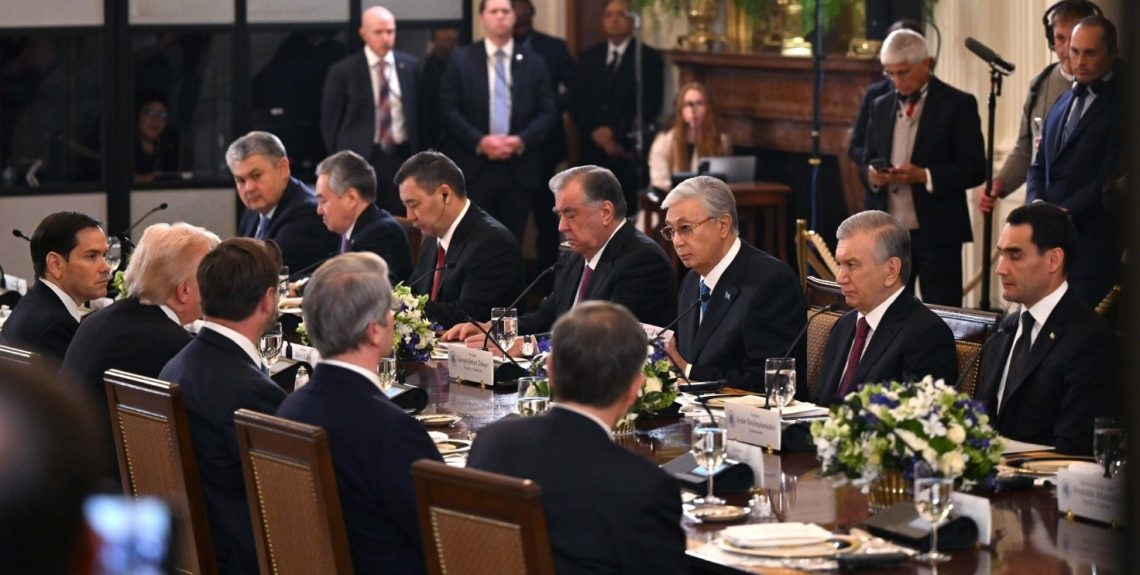
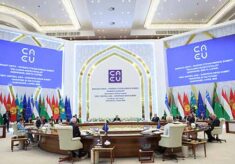
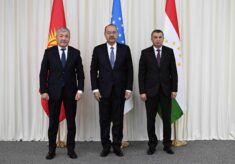
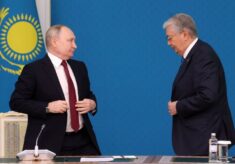
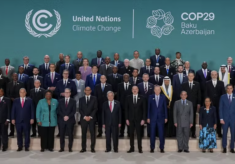
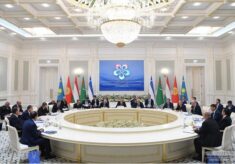
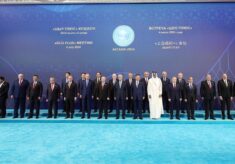
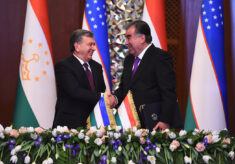
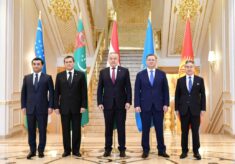
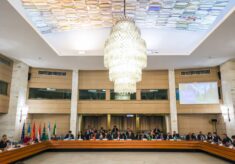
On 6 November, the five Central Asian presidents gathered in Washington with US President Trump within the C5+1 multilateral cooperation format, a lesson learned from the Chinese experience of the 14/16/17+1 format in Central and Eastern Europe (2012). Given the strategic importance and geopolitical implications of this collaboration, international media extensively covered the meeting, emphasising the United States’ expanding role in the region, even though the trade deals and promised investments still need to be implemented to support this ambition.
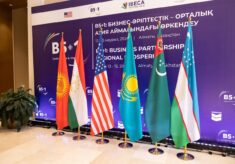
The meeting in Washington marked the tenth anniversary of a format inaugurated in 2015, which has gradually evolved into a high-level political and economic forum through the creation of the parallel B(Business)5+1 format and the involvement of the heads of state and government of the five Central Asian republics during the Biden Administration in 2023, while previously the 1+5 format included only foreign ministers. The same regional format was then copied by China in 2020.
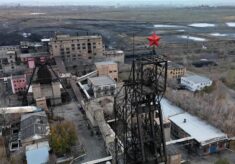
Despite the signing of significant economic and trade agreements and the strengthening of political dialogue between the parties, the shared priority clearly centred on deepening cooperation in the mining and extractive sector, which is increasingly becoming a new arena of geopolitical competition among external players.
From Washington’s perspective, access to Central Asia’s mineral potential represents an important opportunity to rebalance the global supply chain for critical minerals and rare earths, challenging China’s near monopoly, since Beijing controls 70% of global rare earth extraction and 90% of the refining process. For Central Asian countries, US technological support and investment could enable them to exploit existing reserves of critical minerals and rare earths, making them relevant suppliers of key minerals needed for the development of clean energy technologies and the defence industry (F. Indeo, “EU-Central Asia Cooperation on Critical Minerals within a Global Geopolitical Race”, TRENDS Research and Advisory, 19 October 2025).
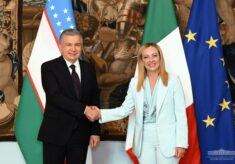
Although the 1+5 format is conceived as an inclusive dialogue platform, Uzbekistan and Kazakhstan appear to be the main beneficiaries of this renewed and strengthened partnership with the USA. In addition to the USD 13,5 billion worth of trade agreements signed between Tashkent and Washington (covering various areas including joint exploration of rare earth deposits, artificial intelligence, and cotton exports), several important agreements were concluded on the sidelines of the event.
These include a 30-day visa exemption for US citizens entering Uzbekistan and a major agreement signed with Plug Power (specialised in hydrogen production), for the supply of electrolysers, that will support Uzbekistan’s goal of developing a green-renewable hydrogen industry. These electrolysers are intended to produce 2 GW of electricity in a project managed by an Australian company aimed at producing zero-emission jet fuel (“Uzbekistan aims to pave way for productive US-Central Asia summit”, Eurasianet, 4 November 2025).
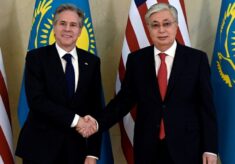
Kazakh President Tokayev announced a series of agreements worth over USD 17 billion, although the most significant deal concerned the mining sector. As part of the Memorandum of Understanding for Cooperation in Critical Minerals, Cove Kaz Capital Group LLC was granted rights (estimation USD 1,1 billion) to develop two of the world’s largest and still unexplored deposits of tungsten, a critical mineral of strategic importance for the defence industry, particularly for radar systems (R. Standish, “Trump and Central Asia Reach Critical Minerals Deal at Washington Summit”, RFERL, 7 November 2025).
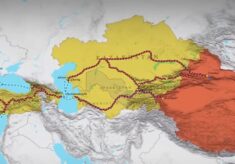
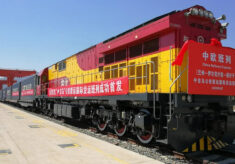
On a geopolitical level, Kazakhstan’s declared intention to sign the Abraham Accords is highly significant, with potential implications for several areas, from regional security to the architecture of regional connectivity, opening opportunities to further diversify transport corridors crossing the region. The Middle Corridor (or East-West Trans-Caspian Corridor) in particular, enabling access to US markets through intermodal land-sea corridors not controlled by Russia or China, is the project where USA intends to collaborate with Central Asian–Caspian littoral republics such as Kazakhstan (and potentially Turkmenistan).
However, Uzbekistan, Kazakhstan, and Turkmenistan have also begun considering north–south rail corridor projects crossing Afghanistan, in order to secure an alternative trade outlet to the Indian Ocean. From the US perspective, this could become an attractive option for exporting Central Asian mineral production, although it still depends on a sensitive precondition: the adoption of a revised approach towards the Taliban regime.
With the aim of strengthening the partnership with Washington through regular and constructive dialogue, Uzbek President Mirziyoyev proposed creating a permanent secretariat for the C5+1 format with a rotating presidency, moving towards greater institutionalisation of the cooperation. He also proposed establishing a financial instrument to coordinate investments within the partnership, and a special committee to control and manage the extraction and refining processes of critical minerals by promoting and implementing a regional approach (President of the Republic of Uzbekistan, “The President of Uzbekistan calls for further expansion of partnership within the ‘C5+1’ framework”, 6 November 2025).
USA–Central Asia cooperation appears promising for both sides, although this growing American interest will inevitably collide with Chinese and Russian influence in the region. In the mineral sector, Beijing remains the main partner for the Central Asian republics, the largest buyer of Kazakh critical minerals, and a major investor in several mines, while Russia traditionally maintains strong influence in the uranium sector in both Uzbekistan and Kazakhstan.
On the other hand, compared to the 2023 New York Declaration under Biden, the diplomatic exercise has lost most of its political and security ambitions in favour of a narrower commercial approach. This is an indirect consequence of the PRC-USA Pusan (Busan) summit (30/10/2025), where the commercial truce has facilitated safer economic competition in the region.