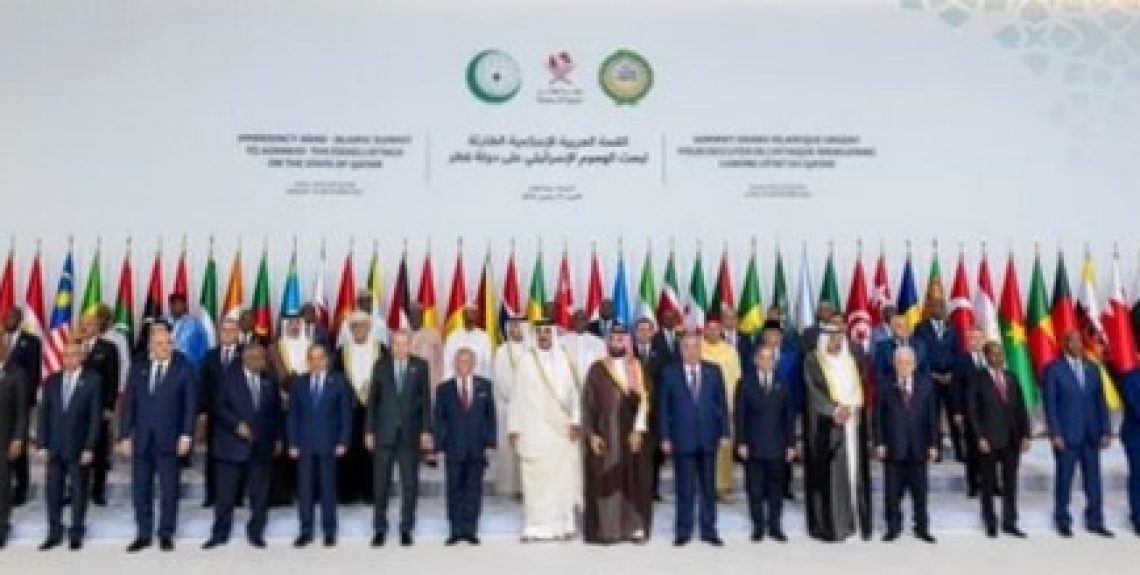
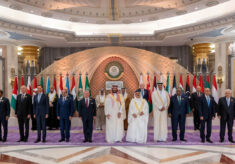
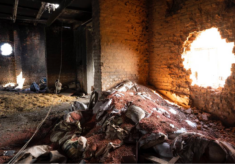
The failed attack on Doha by the Israeli military forces on the 9th of September, that killed five Hamas minor leaders, was aimed at cutting down any possible mediation, the country’s diplomatic ambitions and its sense of security. Following the attack, an emergency summit of the Arab League, the Organisation of Islamic Cooperation (OIC) and The Gulf Cooperation Council (GCC) leaders took place in Doha.
Even though the GCC’s pledged to “activate a joint defence mechanism” to build up “Gulf deterrent capabilities” as a result of the summit, that was opened by Qatari Emir Sheikh Tamim bin Hamad Al Thani, who called the Israeli bombing “blatant, treacherous, and cowardly”, differences among the Arab and Islamic leaders remain.
When the summit was being held in Doha, US Secretary of State Marco Rubio travelled to Israel to meet Netanyahu, who again threatened to target Hamas leaders if Qatar did not expel them. In the meantime: Trump repeated his assertion that Israel would not strike Qatar again; Benjamin Netanyahu was induced to present formal apologies to Qatar for the attack (1st of October) and the American president signs executive order stating that any military action against the Gulf state will be considered a threat to the peace and security of the United States”.
Qatar hosts the largest US military base in the Middle East and a Turkish military base (Tariq bin Zayat army troops and air force units; Aksaz Naval Base naval units; Khalid Bin Al Walid Military Camp, joint military command with host nation). In 2022, the Biden administration designated the State of Qatar as a Major Non-NATO Ally. It was the third country in the Gulf region to become a major non-NATO ally after Bahrain and Kuwait.
Turkey’s military presence in Qatar was established with the goal of contributing to the defence of the Gulf nation. In 2017, when Qatar faced a diplomatic crisis with Saudi Arabia, the United Arab Emirates, Bahrain within the GCC and Egypt, Turkey increased its troop presence in Qatar to support the nation’s security. The Gulf countries in the meantime demanded that Turkish troops leave Qatar as part of their efforts to normalize relations with Doha.
Since the Arab Spring in 2011 Qatar and Turkey have given assistance to Islamist groups such as the Muslim Brotherhood that are labelled Terrorist Organization since 2015 by the governments of Bahrain, Egypt, Russia Saudi Arabia and the United Arab Emirates. Hamas is considerate a Palestinian branch of the Muslim Brotherhood and as such, it is close to the Political Islam spread by Qatar and Turkey.
In August, US Secretary of State Marco Rubio said in an interview in a US TV channel that his country is “in the process” of classifying the Muslim Brotherhood as a terrorist organization, noting that it is “under preparation”. He continued, saying that the classification process is “long and complex, but work is underway.”
In June, the H.R.3883 was introduced as legislation to Congress to designate it as a terrorist organization (Muslim Brotherhood Is a Terrorist Organization Act of 2025). According to Rubio, the process “involves a thorough review of each branch of the group individually, with documentation of evidence to ensure that the decision withstands legal challenges.” Rubio considered that the “Muslim Brotherhood” raises “serious concerns.”
If on one side, there are Turkey and Qatar that give support to the Muslim Brotherhood leaders, on the other side, the Gulf monarchies, Jordan and Egypt are afraid of the Political Islam’s spread by the Muslim Brotherhood’s branches in the MENA region. As far as the Israeli attack in Doha is concerned, it will accelerate the US decision regarding what to do with Turkey and Qatar and their stance on Muslim Brotherhood. In the meantime, the Abraham Accords that normalised relations between Israel and Arab and Muslim states, in particular with United Arab Emirates and Bahrain, should not undergo any changes.
Nevertheless, if actually there is no withdrawal from the accords, any accession is being put on hold by prospective countries, starting with Saudi Arabia, and the same happens with the existing relations (including people-to-people ones and excluding highly classified defence and security dossiers), until the Gaza and Palestinian issue are concretely resolved. The Trump administration is quite buoyant both about the prospects of its 20-points peace plan and even about Iran’s accession to the normalisation agreement, but reality, as in Ukraine, could prove to be more complex than hoped.
By Simone Nella, independent strategic analyst, lecturer and Arabist.