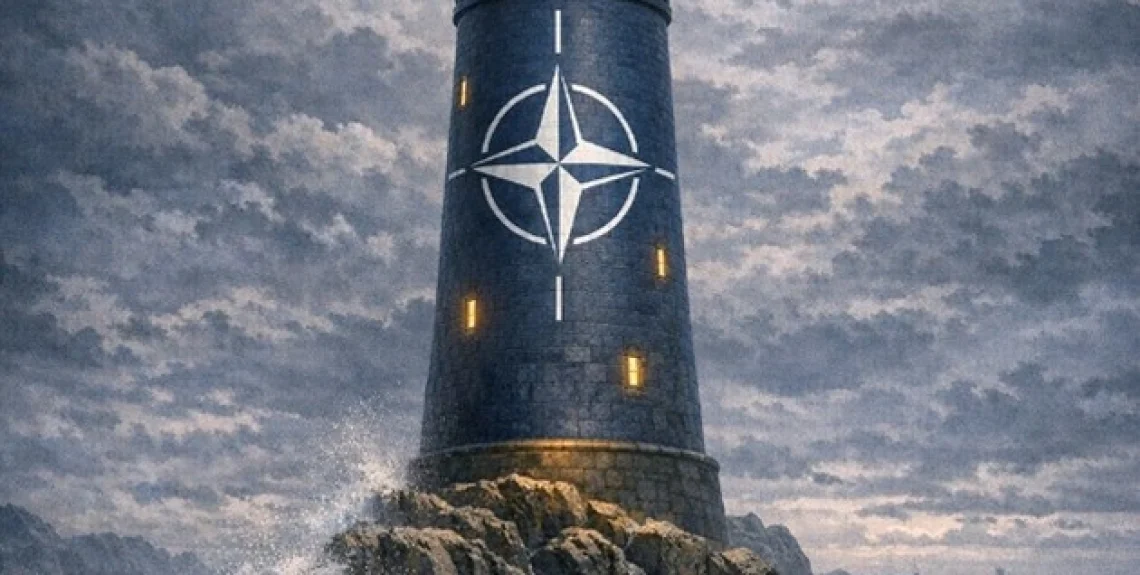
In recent years, a growing number of voices within US policy circles have begun to question the value of permanent alliances, particularly NATO. What was once a debate centred on burden-sharing has gradually shifted toward burden-dodging and aiming in the end at outright burden-shedding. This evolving narrative deserves careful scrutiny, because impulsive decisions regarding the Alliance could carry significant strategic consequences for both the United States and its allies.
Critics of NATO advance several arguments. They claim the Alliance provokes Russia and China, constrains US strategic flexibility, encourages irresponsible behaviour among member states, and risks entangling allies in unwanted conflicts. They also argue that permanent alliances are historically anomalous, pointing out that before World War II, partnerships were typically temporary and contingent.
Yet a closer examination reveals that these claims are often out of touch with reality. NATO’s geographic scope, clearly defined in its founding treaty, limits its operations to the North Atlantic area (north of the Tropic of Cancer). China, therefore, lies outside its remit, and Beijing is well aware that partnerships in the Indo-Pacific are not extensions of NATO. Moreover, the Alliance has never prevented the United States from pursuing its own political initiatives. From the détente with the Soviet Union (1969) to Nixon’s opening to China (1972), NATO has often gone beyond an open-minded stance by actively favouring those developments: e.g. the Harmel doctrine on “deterrence and dialogue” (1967) or by supporting a strong common position in the Euromissile crisis (1977-1987).
After the Cold War, NATO again proved adaptable, supporting improved relations with Russia in the 1990s and 2002 (the landmark Pratica di Mare Agreement), and was indeed decisive in invoking article 5 after al-Qaeda’s attacks in 9/11. Even when, not due to NATO’s actions, relations with Russia soured, the Alliance was instrumental in de-escalating tensions and followed the US lead during all China policy developments. Summing up, NATO may be seen as a threat by Moscow’s and Beijing’s propaganda machines, but surely it is very hard to imagine that it obstructed America’s path in shaping its relations.
The argument that alliances must change because national interests evolve is a truism. However, adaptability does not require abandoning permanence. NATO has repeatedly demonstrated its capacity to evolve, addressing multiple challenges (e.g. Cuba, France, Vietnam, Cyprus, former Yugoslavia, 9/11, Afghanistan, Iraq, etc.). Both the US National Security Strategy and the National Defense Strategy, exclude abandoning Europe, even less because NATO is a permanent alliance.
Equally questionable is the notion that NATO creates a “moral hazard,” allowing some members to behave provocatively under the protection of collective defence. In reality, the Alliance’s mechanisms restrain escalation during crises, leaving aside bilateral issues. Articles 4 and 5 do not imply automatic military responses or unlimited protections, since each member retains sovereignty over its decisions. The measured NATO reactions to the 2015 Turkey-Russia incident or to the Russian drones overflying Polish territory (2025), illustrate this principle clearly.
Similarly, fears that NATO would drag countries into unwanted wars, often conflate alliance commitments with bilateral political choices. Participation by Denmark, Norway, United Kingdom, for instance, in attacking Iraq in 2003 was driven primarily by national decisions and relations with Washington, not by NATO obligations. Even in Libya (2001), intervention resulted from UN and Arab League mandates and consensus among allies, and not by some moral bond to the upkeeping of the Alliance.
Historically, the shift toward permanent alliances was not arbitrary, but a response to failure. The temporary alliance system of the early 20th century, combined with US isolationism, contributed to global turmoil and ultimately to the catastrophe of World War II. NATO emerged from the recognition that security had become indivisible among allies in an interconnected world. Since then, the United States has retained full freedom to act with ad hoc coalitions (1991 Second Gulf War, liberation of Quwait; 2001, response in Afghanistan to 9/11; 2003, Third Gulf War, attack to Iraq), while relying on NATO when some coalitions failed (Iraq and Afghanistan).
NATO was born by sheer necessity after the Berlin Blockade (1948-1949) and moved its first steps under the shadow of the Korean War (1950-1953), dashing Truman’s fantasies to protect Europe “over the horizon”. It is an irony that a decade after (1959), Eisenhower started complaining about an unequitable burden sharing, knowing full well that Europe was slowly recovering from war under direct American financial assistance.
Proposals to replace NATO with more flexible or time-limited arrangements simply overlook the depth of its integration (the same error done with Brexit). Over 75 years, the Alliance has built an unparalleled system of military interoperability, shared logistics (often on US weapons), common doctrines and training, supporting integrated, efficient command structures. Nor do they take into account the Pandora’s box of negotiating new security arrangements in a polarised atmosphere, while handing to global competitors a golden opportunity to divide the transatlantic community.
NATO has its flaws, but it benefits (political cohesion, credible deterrence, strategic stability, collective defence, some economies of scale) far outweigh its drawbacks, not to mention a very hazy debate on financial burdens. In reality, this permanent structure is continuing to do its job so well that even neutral countries with considerable autonomous defences preferred to become allies. Common sense suggests a very simple criterion: “If it ain’t broke, don’t fix it”.