“The spirit of our endeavour is, To strive, to seek, to find and not to yield”

Alessandro Minuto-Rizzo, President

South Africa’s strategic balance: a path to reshaped NATO engagement?

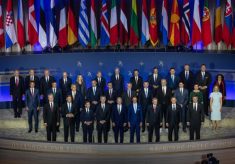
Source: NATO. NATO’s Chair of the Military Committee, with military top officers from South Africa, Lesotho and Ivory Coast, at the US Africom African Chiefs of Defense Conference, 24-26 June 2024.
Traditionally, situated outside NATO’s geographic and defence remit, apartheid-era South Africa engaged in restricted and covert Cold War-era cooperation with select members of the alliance as a countermeasure to Soviet influence. Never authentically anchored near the NATO harbour or viewed as a prospective member, apartheid Pretoria pursued strategic autonomy, select economic ties, regional hegemony, non-alignment, developing ‘home-grown’ deterrent and nuclear capability, obviating dependence on external security assurances.
These apartheid legacies inform today’s equidistant diplomacy, which is underpinned by historical grievance, sovereignty, and non-alignment. While formal alignment remains unlikely, South Africa’s geostrategic weight and balanced posturing invite a different modality, pragmatic NATO re-engagement anchored in technological collaboration, aligning mutual interests without overt militarisation.
South Africa’s geostrategic significance
South Africa holds a unique geostrategic position regionally, continentally, and globally. It is the continent’s most industrialised economy, with the Cape of Good Hope (the direct passage between the Atlantic and Indian Oceans) serving as a vital maritime passage for global trade, a strategic alternative and a naval surveillance hub. The country is also a pivotal logistical node for Antarctic operations and maritime routes amid regional and global instability.
South Africa is also a strategic and diplomatic powerhouse. As a founding member of the AU and SAD, the country has been engaging in peacekeeping and mediation efforts across Africa, albeit with criticism. Pretoria’s membership in the AU Peace and Security Council and contributions to UN peacekeeping continue to consistently demonstrate commendable political will and unwavering diplomatic leadership despite strategic and capacity constraints. Furthermore, South Africa’s established naval infrastructure and maritime security commitments allow it to play a dual role in the Indo-Atlantic and Indo-Pacific.
Most importantly, South Africa’s residual blue-water capability, long-standing peacekeeping tradition and presence in global forums like the G20, BRICS, and the AU render it a credible actor in shaping regional, continental, and international security norms, despite persistent constraints that simultaneously present untapped NATO potential engagement opportunities.
From pivot to purpose: reimagining NATO-South Africa engagement
South Africa’s recent diplomatic manoeuvres, abstentions on UN resolution votes concerning the Russian invasion of Ukraine, joint naval drills with Russia and China, and intensified BRICS plus engagement have raised concerns among Western partners. Yet such positioning should not be misread as an unequivocal ideological alignment. Instead, it embodies a pragmatic foreign policy prioritising sovereignty, national interests, strategic autonomy, and the pursuit of multipolarity, albeit inconsistently.
Pretoria’s recalibration arises partially from perceptions of imbalance in its international alliances. While the Global South alternatives offer political resonance and some degree of economic utility, relationships with the West are often perceived as transactional, conditional, asymmetrical and lacking strategic respect.
Source: Author’s own visualisation using Datawrapper; data drawn from multiple sources, 2025.


Source: Author’s visualisation on multiple sources. South Africa’s joint military and naval exercises by partner affiliation, 2015-2025.


However, a brief illustrative analysis of the frequency and number of South Africa’s joint military exercises with BRICS and Western countries reveals a balanced and prudent approach to defence diplomacy. Pretoria’s carefully calibrated engagement affirms non-alignment: a balancing act that neither rejects nor fully embraces either side.  Thus, rather than being viewed as a strategic drift, this posturing should be interpreted as one of stability, historically rooted in national interest.
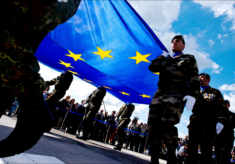
While complex, South Africa’s balancing act presents a credible opportunity for NATO to revisit carefully the potential for reengagement with states that are neither opponents nor allies. In such instances, the Alliance potentially may pursue a nuanced and non-intrusive strategic engagement, grounded in mutual strategic respect and shared innovation-driven interests. This happens already in all NATO partnerships, particularly in the Mediterranean Dialogue, engaging all North African countries, except Libya for obvious reasons. Moreover Africa is one of the main awareness tasks of NATO’s Strategic Direction-South HUB (NSD-S HUB) in Naples and there is a NATO liaison office at the HQ of the African Union in Addis Ababa. The latest cooperation developments between the Alliance and the AU date to 2021 when a Cooperation Plan was established to gradually enhance the military cooperation offered to the AU and the AU Commissioner for Political Affairs, Peace and Security, Ambassador Bankole Adeoye, visited NATO Headquarters. Is clear that the 2022 invasion of Ukraine and the successive change of US administration have shifted the attention elsewhere during these years.
Nevertheless, despite some lingering bilateral issues, one could envisage as practical potential entry points for a NATO-South Africa reengagement aspects like: maritime domain awareness (MDA), support to peace operations (as it happens already in Somalia with the AU), cyber defence, disinformation resilience, and defence technology collaboration, areas where South Africa carries its inherent potential and expertise.
Conclusion: unbroken moorings, reimagined harbours
A strategic neglect may often breed drift, but South Africa’s strategic posturing cannot be categorised as such. Historically, the country has never been anchored to NATO harbours. It is a sovereign democratic state, focused on its national interests, navigating a fractured world. Thus, the Alliance and its members should resist interpreting Pretoria’s balancing act as a loss and instead recognise it as an invitation to engage differently, with strategic creativity, humility, flexibility and a tailored approach.
In the contemporary multipolar world, partnerships are no longer binary and are highly fluid. NATO has already adopted in North Africa measured, tailored, innovative approach, eschewing patronage: this has produced remarkable results, despite a growing Russian influence in the Sahel and other Sub-
Saharan countries. Over time, the Alliance could gain in South Africa not an estranged acquaintance, but a sovereign equal, credible partner, not a school pupil but a peer.

Kateryna Ryabchiy

Ms Ryabchiy is an international security and intelligence professional with a Master of Security Studies (with distinction) with operational exposure across the United States, Ukraine, South Africa, and Yemen. Holding a combination of field-tested judgement and refined analytical acumen in intelligence-led policy research.

Share on

Archive

Subscribe to our newsletter