In an age where drones patrol the skies and nuclear submarines haunt the ocean’s depths, the deadliest weapon is neither hypersonic nor radioactive. It hums quietly in a forgotten basement in Queens, encased in a steel box no larger than a suitcase. It does not detonate – it deceives and it can sever a nation’s grasp on reality with the tap of a key.
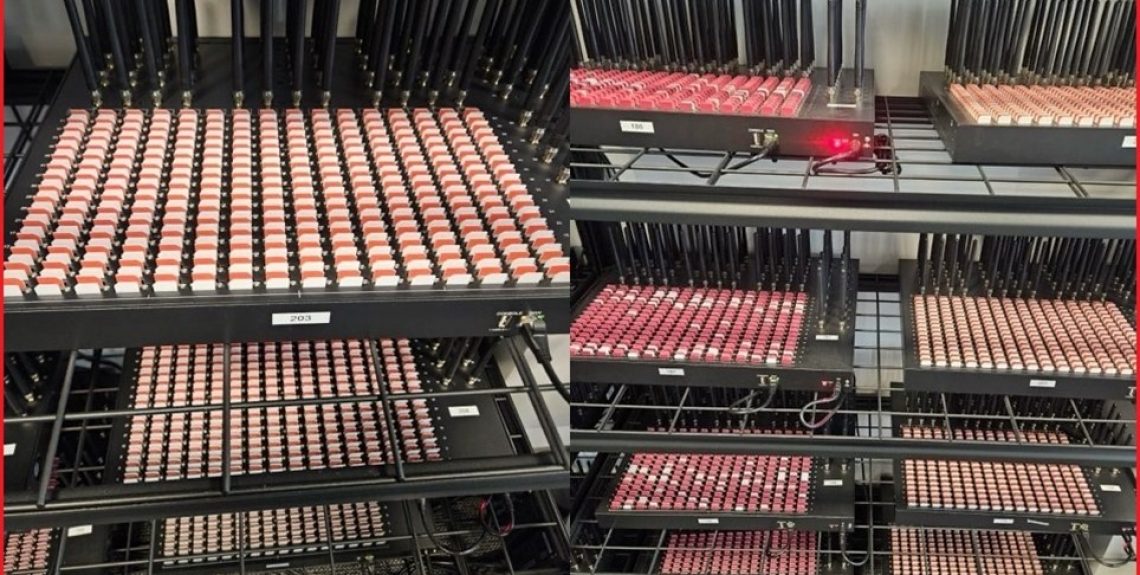
Welcome to the realm of SIM farms: clandestine forges of digital disarray. Each SIM card, stripped from its plastic cradle, is a faceless soldier awaiting orders. The GSM gateways, aligned like artillery batteries, fire signals: millions of SMS pulses per minute, generating seeds of doubt, sparks of panic, propaganda reverberations. Netflix might locate these farms in flashy sci-fi warehouses with black suit guards. Reality is slightly different. The building is anonymous, stinking ozone and overheated by overworked servers; in an eery silence hundreds of green LEDs blink randomly in what is a new war room where bandwidth is the main logistics.
The lines of communication are the infamous “grey routes” — unofficial, untraceable data corridors that bypass the monitored highways of global telecom infrastructure. A message might appear to originate from a local New York number, yet be triggered by an operative far away. Anonymity is its armour. Ubiquity, its sword. Illegality, the stuff of crime genius.
Intelligence agencies had long dismissed these systems as tools of petty fraud—spam, robocalls, the old wangiri scam (from the Japanese, one ring and cut off; a scam inducing to recall a number then rerouted to an expensive international call). But a colder, more calculating adversary may glimpse their true potential: this was not about stealing money, but about blurring consensus and truth.
Imagine Day X. A diplomatic summit in Manhattan. World leaders gathered under one roof. Then, the network awakens. A flash flood of messages: “Imminent attack at Grand Central”, “Evacuate the Financial District”, “Bank collapse—withdraw funds now”.
Thirty million messages per minute: Germany’s population can be reached by a fake panic message in 150 seconds.
The messages are believed because they appear local, familiar. Emergency lines are jammed. Cellular networks buckle. The city spirals into self-inflicted chaos. The cognitive war is won not when the enemy is destroyed—but when he destroys himself, guided by a phantom hand.

And then came September 2025. The wake-up call no one wanted.
In a raid worthy of a Hollywood script, the US Secret Service stormed multiple sites across New York and New Jersey. What they uncovered was staggering: over 300.000 active SIM cards—an entire digital armada. No uniforms. No flags. Just cold, calculating technicians and humming machines.
Investigators traced encrypted communications to hostile cells and threats against high-ranking officials. But the true terror lay not in what had been done—but in what could have been. According to a first declaration by a special agent of the US Secret Service, the system had the capacity to black out New York’s communications during a global event, rendering the world’s nerve centre deaf and blind. Other third-party private evaluations are markedly different.
According to them, these illegal networks typically are used for:
Robocalls, mass SMS, scams
Grey-route call termination (bypass billing)
SIM renting for disposable identities
Call-centre/IVR abuse via telephony denial-of-service (TDoS)
What instead such setups are unlikely to do it to:
Paralyze New York’s telecom infrastructure
Enable P2P encrypted comms for criminals
Act as lawful-intercept systems or IMSI-catchers
Nevertheless, SIM farms have had a concrete operational use. From the frozen trenches of Ukraine, where Russian SIM farms demoralized troops via SMS, to the industrial-scale phishing operations funding terror networks, the pattern is clear: anonymity, automation and speed. In this digital epoch, there is no visible frontline. The battlefield is in our phones and minds. Defence lies not in firewalls or encryption, but in the critical thinking of every citizen.
The Anatomy of a Digital Coup
The ability to send in one hour 1.800.000.000 anonymous, geo-targeted messages is a goldmine for state actors and extremist groups alike.
Consider a coordinated campaign for three objectives:
Mass Panic: False alerts of attacks, evacuations, or financial collapse can cripple emergency infrastructure.
Electoral Manipulation: Smear campaigns or disinformation blasts can sway public opinion in the final hours before a vote.
Radicalization: Extremist content, tailored to specific demographics, can fracture societies and foment unrest.
The use of local numbers, enabled by grey routes, lends these messages a veneer of authenticity, bypassing the scepticism reserved for foreign or unknown senders.
SIM farms and grey routes enable seamless identity spoofing. Messages appear to come from trusted institutions like banks, police, government agencies.
This opens the door to:
Sophisticated Phishing: Directing victims to malicious sites cloaked in officialdom.
Extortion and Coercion: Threats masked as legitimate warnings, exploiting sensitive data.
The fragmented nature of grey route traffic renders attribution nearly impossible. Cybersecurity teams are left chasing ghosts. Meanwhile, the illicit traffic fuels a shadow economy. Tax evasion, telecom fraud, and criminal finance flow through these networks, funding everything from terrorism to unconventional warfare, who in turn generate a host of blended threats, including organised crime, interference, subversion, corruption, hybrid attacks etc.
In a hybrid warfare scenario, a coordinated SIM farm assault could deliberately try to overload specific local cellular network segments. Emergency calls could fail. Military communications civil backups could falter. A tactical digital blackout, executed without a single missile fired, where electronic, cyber and psychological attacks are combined.
The “New York Case” is not an isolated anomaly. It is a warning flare.
In Ukraine, Russian SIM farms sowed disinformation and despair.
In Thailand, Operation “Grey Dragon” uncovered 590.000 SIMs used for fraud and illicit traffic.
Across Europe, Europol dismantled cybercrime-as-a-service platforms renting phone numbers for phishing on an industrial scale.
The message is clear: the war for reality is underway. And the first casualty is trust. In this new era, the most dangerous weapon is not the one you see—but the one you believe to.