In today’s confused international affairs’ scene, the call that NATO is dead and that the European pillar of the Alliance is useless, is repeated so often that it is becoming a truism. Let’s be honest: it is an ideological statement, cloaked by factoids.
The US National Security Strategy of 2025 states as a core, vital interest “to support our allies in preserving the freedom and security of Europe”. It adds, that “wealthy, sophisticated nations that must assume primary responsibility for their regions and contribute far more to our collective defense” and that the USA want aim at “preventing the reality, of NATO as a perpetually expanding alliance”.
Consequently, these relevant passages imply that: a) the USA remain engaged in Europe because it is a core, vital interest; b) primary responsibility for a region means being the first line of conventional defence in that area; c) NATO has its territorial limits and they are in a part of the European continent, not all the continent.
The US National Defense Strategy of 2026 is also quite telling: “… as the Department rightly prioritizes Homeland defense and deterring China, other threats will persist, and our allies will be essential to dealing with all of them”. Then “In Europe and other theaters, allies will take the lead against threats that are less severe for us but more so for them, with critical but more limited support from the United States”. About NATO “The Department will also continue to play a vital role in NATO itself” and regarding Russia and Europe “Moscow is in no position to make a bid for European hegemony. European NATO dwarfs Russia in economic scale, population, and, thus, latent military power”.
The bottom line is: 1) allies are essential and they take the lead in Europe; 2) the USA will continue to play a vital role in NATO; 3) European NATO allies have the wherewithal and potential to express a military power dwarfing the Russian one.
So much for the media statements implying that the Alliance is useless for the USA: the reality is that the do not want to relinquish a comfortable strategic position and tool. Given the serious global constraints of the US military machinery, the USA are forced to abandon the previous paradigms that required the military to deploy and win in two major contingencies or one and a half major contingency. The choice is on US homeland and on Asia-Pacific vis-à-vis China, clearly using deterrence (not war) to achieve the good old Cold War “peaceful coexistence”.
De facto, the USA are asking for a European pillar within NATO capable to guarantee the conventional deterrence and defence of the continent and to protect Ukraine.
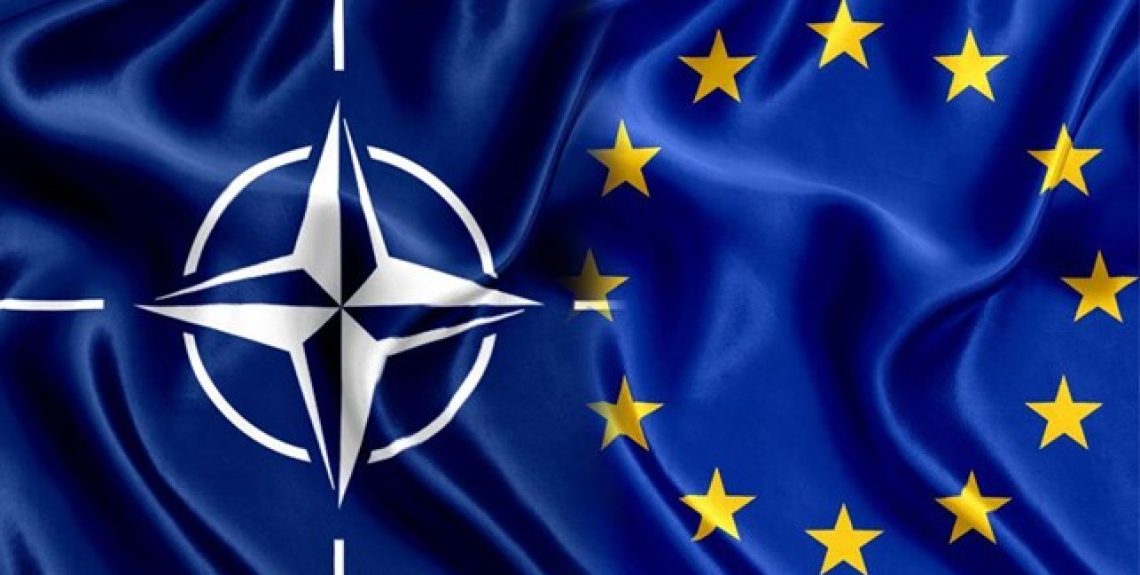
Within NATO this concept is well known, and it has been formulated and practiced. Since June 1992 NATO Foreign Ministers supported the then Western European Union as means to strengthen the European pillar of the Alliance and till today NATO itself records the achievement of 72 milestones in the EU-NATO relationship. The Strategic Concept of 2022 clearly recognises the value of a stronger and more capable European defence (para 43).
Actually, the joint activities, meetings and agreements between are so frequent and complex that the two organisations are so intertwined among each other, that the European pillar is already a double hatted exercise in daily practice. Since 2022, the presence of EU top representatives at NATO summits is normal and vice versa for important EU meetings.
Within the Alliance, also recent opinions have basically repeated what has been said and done in 33 years and, since they value the EU partnership very much, they dutifully insist on spending more and fast and on an effective synergic division of labour. In short: a stronger and more capable European defence is an asset, not a liability.
As for the European pillar, great is the confusion under sky since then German Foreign Minister, Joshka Fischer, mentioned it in 1999 as element for the transatlantic bridge. Its meaning ranges from the constitution of an institutional and political European caucus within NATO to the effective EU defence and security coordination among European allies within the Alliance. In 1998, then Secretary of State, Madeleine Albright, encouraged European efforts, provided they avoided four problems: delinking at decisional level, decoupling vis-à-vis nuclear deterrence, discriminating and duplicating.
In the meantime, US economy has significantly shrunk, the deficit has unabatedly swollen, and the military capabilities have been reduced to the point that Washington issues a quite austere defence strategy, that is half global, heavily relying on allies for the other hemisphere.
The first point that has been de facto revised has been duplication because everybody has understood that there is an unnecessary duplication and a necessary one. If one, for core vital interests, wants the essential European allies to take primary responsibility for conventional deterrence and defence, one cannot ask them to have half capable forces, because an important number of limited and critical assets will be deployed elsewhere. It would be imprudent to bet that, in case of a serious contingency, the 7th Cavalry will arrive in time, especially if it is engaged elsewhere, as explicitly scenarized by the US Defense Strategy.
The USA will continue to play a vital role in nuclear deterrence and other capabilities where their leadership is consolidated, but the European allies must pass from a latent to a real military power and they will need short logistic chains for obvious reasons. This is how the European defence will become an asset and a pillar within NATO, ending Byzantines disputes on burden sharing and assuring a credible Alliance where it is needed.
Discrimination towards non-EU members and decisional de-linking by European allies have, until today, remained academic hypotheses and they will remain, as long as a viable two-way street at wider transatlantic level is present.
Last point, expenditures: there are pledges and then hard financial realities. Not even the USA envisage seriously to spend a 5% defence/GDP ratio because facts are stubborn. On the other hand, the European allies have a hard work to do if they want to reduce unnecessary duplications among themselves. There will be neither effective NATO sets of forces, nor an imaginary “European Army” with nationally fragmented logistics. The Ukrainian defence is paying dearly this chaotic situation by the day, and this is a clear warning to all European allies.